Electric Wheel Loader vs Diesel Wheel Loader: A Complete Cost Comparison
Sep 18, 2026
An electric wheel loader vs diesel comparison starts with a practical question: which machine can handle your material at a lower total cost without disrupting production? Purchase price matters, but energy consumption, charging access, maintenance requirements and annual productive operating hours also influence the result.
Electric loaders can offer attractive economics at sites with reliable electricity, predictable shifts and substantial workloads. Diesel loaders remain a practical choice when power is unavailable or the work schedule leaves little time for charging. The right purchasing decision depends on your loading cycle and infrastructure, not just the energy source.
This guide compares performance, daily operating requirements and ownership costs, with an illustrative calculation you can adapt to your site.
Power & Performance Comparison
For a wheel loader, powertrain performance ultimately translates into how efficiently it can dig, lift, travel and unload. To determine whether an electric machine can handle the same tasks as a diesel model, compare rated payload, traction, gradeability and actual output rather than power ratings alone.
The table below compares the basic specifications of two 5-tonne wheel loaders:
Specification
LT950EV Electric Loader
LT955 Diesel Loader
Power source
Battery-electric drive
Diesel engine
Rated load
5,000 kg
5,000 kg
Operating weight
18,500 kg
16,500 kg
Bucket capacity
3 m³
3 m³
Maximum climbing angle
28°
28°
Maximum dump height
3,350 mm
3,200 mm
Lift time
5.8 seconds
≤6.8 seconds
Specifications are provided for comparison. The configuration supplied must be confirmed in the technical agreement.
Both machines can be considered for similar load requirements, although their configurations are not identical. When selecting a loader, match material density, bucket capacity, actual payload and travel distance to your application.
How Does Gradeability Compare?
Neither diesel nor electric power alone guarantees better climbing ability. Loaded climbing performance depends on traction, gearing, continuous power output and cooling capacity.
For example, the LTMG LT950EV electric loader and LT955 diesel loader both have a specified maximum climbing angle of 28°. Their power source alone therefore provides no basis for concluding that one has better gradeability.
For electric equipment, confirm whether extreme temperatures or a low battery state of charge can limit power output. With either type, assess loaded travel speed on your actual ramps, braking performance and the manufacturer’s operating limits.
A published maximum climbing angle does not mean the machine can safely work on every slope at that angle. Load position, ground conditions and travel direction all affect stability.
Charging Time, Range and Refueling Efficiency Comparison
Runtime Depends on the Work Cycle
Battery capacity alone cannot tell you how long a loader will operate. Continuous truck loading, long loaded travel distances, steep ramps and power-intensive attachments have different energy demands from intermittent yard handling.
A useful planning formula is:
Estimated operating time = usable battery energy ÷ average battery energy consumption per operating hour
For example, if 120 kWh is available within the planned operating charge range and the machine consumes an average of 20 kWh per operating hour, estimated runtime would be approximately six hours. This is a calculation example, not a measured result for a specific model.
Allow for reserve charge, battery aging, ambient temperature and heating or air-conditioning demand. Also distinguish an eight-hour shift that includes breaks from eight hours of continuous loading.
Charging Must Fit the Production Schedule
When fuel is available close to the machine, diesel refueling generally involves a shorter interruption. Electric charging is easier to integrate when the loader already stops overnight, during lunch or between shifts.
Before ordering, confirm:
The starting and target charge levels behind the stated charging time.
The machine’s maximum accepted charging power.
Available site voltage, electrical capacity and charging connector compatibility.
Whether multiple machines will share the same electrical supply.
Charger installation costs and the production cost of any additional downtime.
The charger’s rated output is only one limiting factor. The machine, battery temperature and site power supply can also restrict charging speed.
Overnight charging that finishes before work begins may have no impact on production. An unplanned charging stop during a busy truck-loading period, however, can be costly even when electricity is inexpensive.
Operating Cost: Electricity vs Diesel Fuel
Calculate Energy Cost per Operating Hour
An electric loader cost comparison should use consumption measured under comparable working conditions:
Diesel energy cost/hour = fuel consumption in liters/hour × delivered diesel price/liter
Electric energy cost/hour = grid electricity consumption in kWh/hour × electricity price/kWh
For electric equipment, use energy recorded at the charger or electricity meter so that charging losses are included. Add demand charges or other electricity tariff costs separately where applicable.
The following example assumes that both loaders complete the same amount of work per productive operating hour. All prices, consumption rates and purchase costs used for illustration are hypothetical inputs, not LTMG quotations, market averages or verified equipment test data.
Assumption
Diesel Loader
Electric Loader
Annual productive operating hours
2,000 hours
2,000 hours
Average energy consumption
8 L/hour
20 kWh/hour measured at the meter
Energy price
$1.20/L
$0.15/kWh
Energy cost per hour
$9.60
$3.00
Annual energy cost
$19,200
$6,000
Under these assumptions, the electric loader saves $6.60 per operating hour, or $13,200 per year.
The result is highly sensitive to local energy prices. If electricity rises to $0.30/kWh, the electric loader’s energy cost increases to $6.00/hour, reducing annual energy savings to $7,200. Before making a purchasing decision, substitute your actual delivered diesel price and electricity tariff.
Extend the Calculation to Ownership Costs
Lower energy costs do not necessarily offset a higher purchase price. A practical ownership cost model is:
Ownership cost = purchase + infrastructure + energy + scheduled maintenance + repairs + financing + downtime − resale value
Include operator costs, tires, insurance and other expenses where they differ between the two options.
Account for Major Cost Uncertainties
Before relying on a payback estimate, obtain the battery warranty terms, capacity-retention requirements, replacement pricing and details of local service support. Include battery replacement in your cost model if the planned ownership period and duty cycle make it a relevant consideration.
Finally, compare cost per tonne of material handled. A machine that completes fewer loading cycles or requires more downtime may have a higher cost per unit of output, even if its hourly operating cost is lower.
Maintenance & Noise/Emission Differences
Electric Power Eliminates Engine-Related Service Tasks
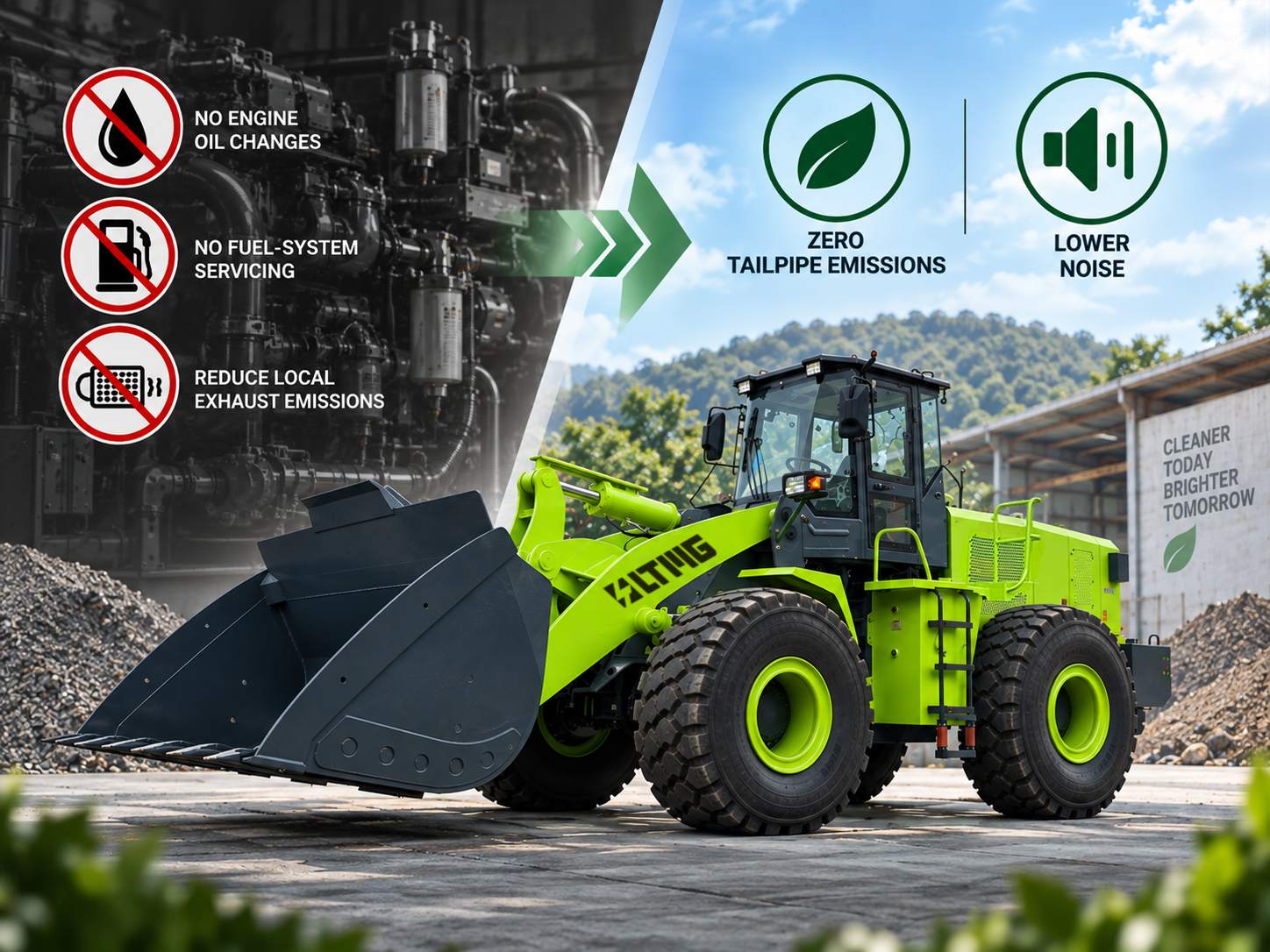
Battery-electric loaders do not require diesel engine oil changes, fuel-system servicing or engine exhaust-aftertreatment maintenance. For diesel equipment, aftertreatment maintenance requirements vary by engine and configuration.
Electric equipment still requires maintenance of hydraulic systems, lubrication points, tires, brakes, axles and electrical components. Cooling systems and charging connections must also be inspected according to the machine’s service schedule.
Zero Tailpipe Emissions and Lower Noise
A battery-powered zero emission wheel loader produces no tailpipe exhaust during operation. This is valuable in enclosed material-handling areas and on projects seeking to reduce local exhaust emissions.
However, “zero emissions” does not mean zero environmental impact. Electricity generation, battery production and the machine’s full lifecycle still matter. Dust from material handling and tire wear also remain.
Removing engine combustion noise can make operation quieter, but hydraulics, fans, alarms and bucket impacts still generate sound.
Which One Fits Your Site: Indoor, Urban or Remote Site?
Site or Operating Pattern
Option to Consider First
Main Purchasing Consideration
Indoor material handling
Battery electric
No tailpipe exhaust; verify machine dimensions, floor load capacity and application suitability
Urban projects with strict exhaust or noise requirements
Battery electric
Confirm project requirements and suitable charging access
Fixed industrial yards with high annual utilization
Battery electric
Ongoing energy savings may offset the higher initial investment
Remote sites with limited electricity
Diesel
Fuel delivery may be more practical than establishing charging infrastructure
Continuous operation across multiple shifts
Depends on site conditions
Compare charging windows, electrical capacity and backup requirements
Occasional or seasonal operation
Compare both carefully
Fewer annual operating hours make it harder to recover the additional electric investment through operating savings
When choosing between an electric and a diesel wheel loader, start with your daily material-handling target in tonnes. Then assess machine capacity, energy supply and ownership costs.
Explore LTMG’s electric and diesel wheel loader ranges and ask the sales team for a comparison based on your required payload, material density, operating hours, travel distance and local energy prices. The quotation should identify the battery configuration, charger, warranty and after-sales support so that your cost estimate reflects the equipment you will actually receive.
FAQ
How Long Can an Electric Wheel Loader Run on One Charge?
Runtime depends on battery capacity, workload, travel distance, ambient temperature and attachments. Confirm whether the supplier’s runtime figure refers to continuous operation or an entire shift that includes idle time or breaks.
How Much More Does an Electric Wheel Loader Cost Than a Diesel Model?
There is no single reliable price premium that applies across all sizes and configurations. Compare quotations with equivalent payload, attachments, warranty and delivery terms, then add the cost of charging infrastructure.
Are Electric Wheel Loaders Suitable for Indoor Work?
Yes. Battery-electric loaders produce no tailpipe exhaust during operation, making them suitable for indoor material handling where the application matches the machine’s capabilities.You still need to confirm machine dimensions, floor load capacity, operating clearances and suitability for the materials being handled. Dust control, general ventilation and any hazardous-area requirements must also be assessed separately.